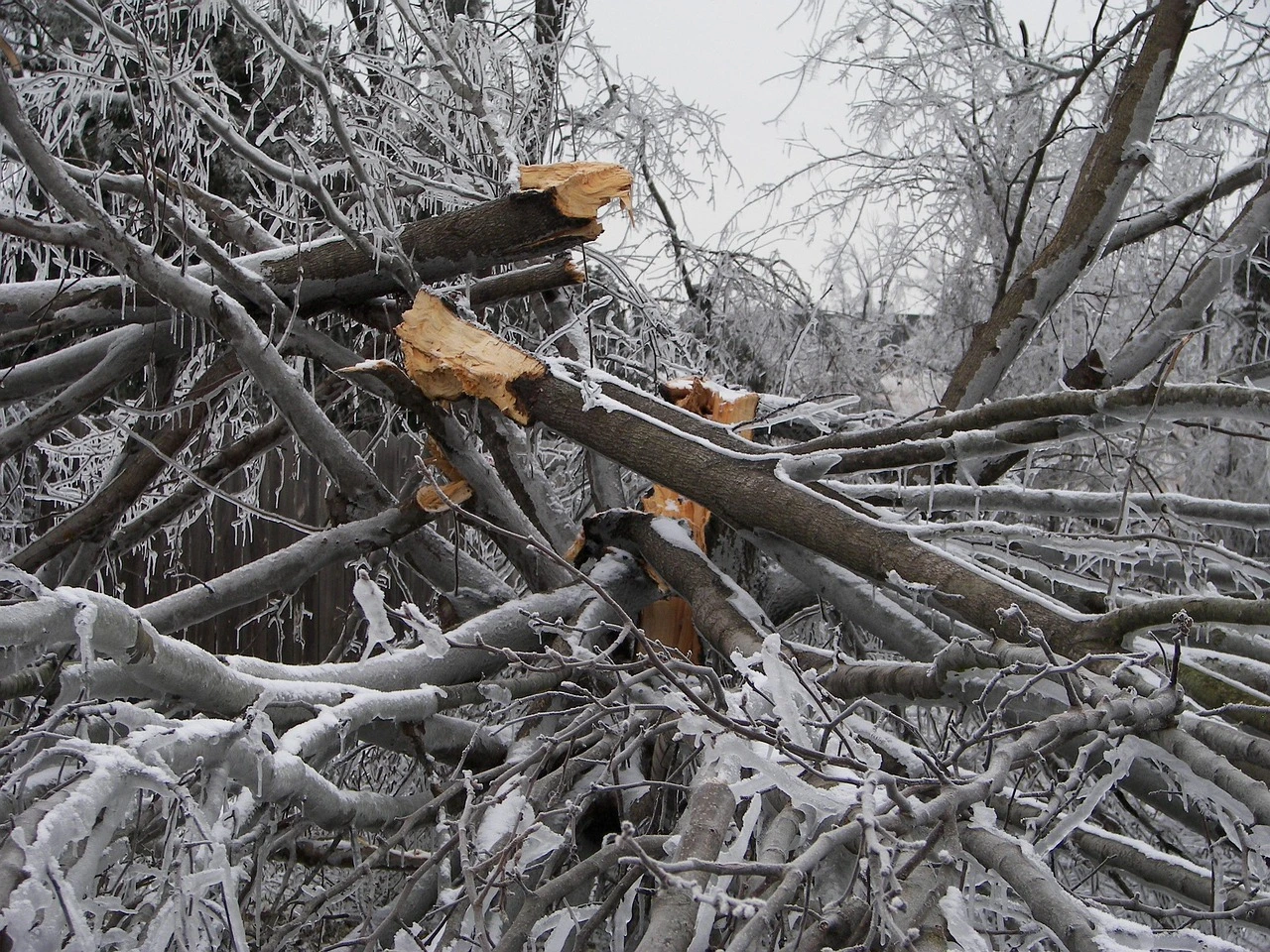
It has been exactly one year since freezing rain began coating Simcoe County in a thick shell of ice — a storm that brought trees down onto power lines, streets and homes, cut hydro for days and left residents across the region in the cold and dark.
The storm, which stretched from March 28 to 31, 2025, became the Insurance Bureau of Canada's costliest severe weather event of the year, with $490 million in insured damage across Ontario and Quebec, according to OrilliaMatters.
Nearly 400,000 homes and businesses lost power across central and eastern Ontario as ice accumulated on branches and wires.
A perfect storm, in the worst way
David Phillips, a climatologist with Environment and Climate Change Canada who lives in Barrie, said the trouble began with a Colorado low — a warm, moist system that moved north into Ontario while cold air sat near the ground.
Rain falling through that cold layer arrived as freezing rain, spreading across surfaces and hardening into what Phillips described as the thickest, toughest ice nature can produce.
This was really a crippling one. This was a very impactful, costly storm.
Phillips told OrilliaMatters the weekend was defined as much by sound as by sight — the ping of ice against windows, the crack of falling limbs, and chainsaws in the days and weeks that followed.
"I used to see, driving around for weeks afterwards, companies removing trees," he said.
Three factors that made it worse
Phillips pointed to the volume of precipitation: between 55 and 65 millimetres of rain fell over the weekend, roughly a month's worth, with a little less than half of it arriving as freezing rain.
There was also duration. Phillips estimated 20 to 25 hours of freezing rain over the three days.
And then came the wind. Winds were light during the storm itself, around 18 to 20 km/h, but on April 1 they began gusting to 50 km/h — adding strain to ice-laden trees and wires even after the freezing rain had ended.
You could hear more cracking and breaking, and that was because of the stress of the winds.
Cold nights amplified the hardship
The timing of the storm deepened its impact. Unlike a summer outage, Phillips noted, temperatures fell below freezing every night in the first week of April 2025.
Roads were closed, power lines were down and trees blocked streets. Basements flooded because sump pumps sat idle without electricity.
A year on, the ice is long gone, but for many in Simcoe County the memory of four days in the dark — and the spring cleanup that followed — remains fresh.