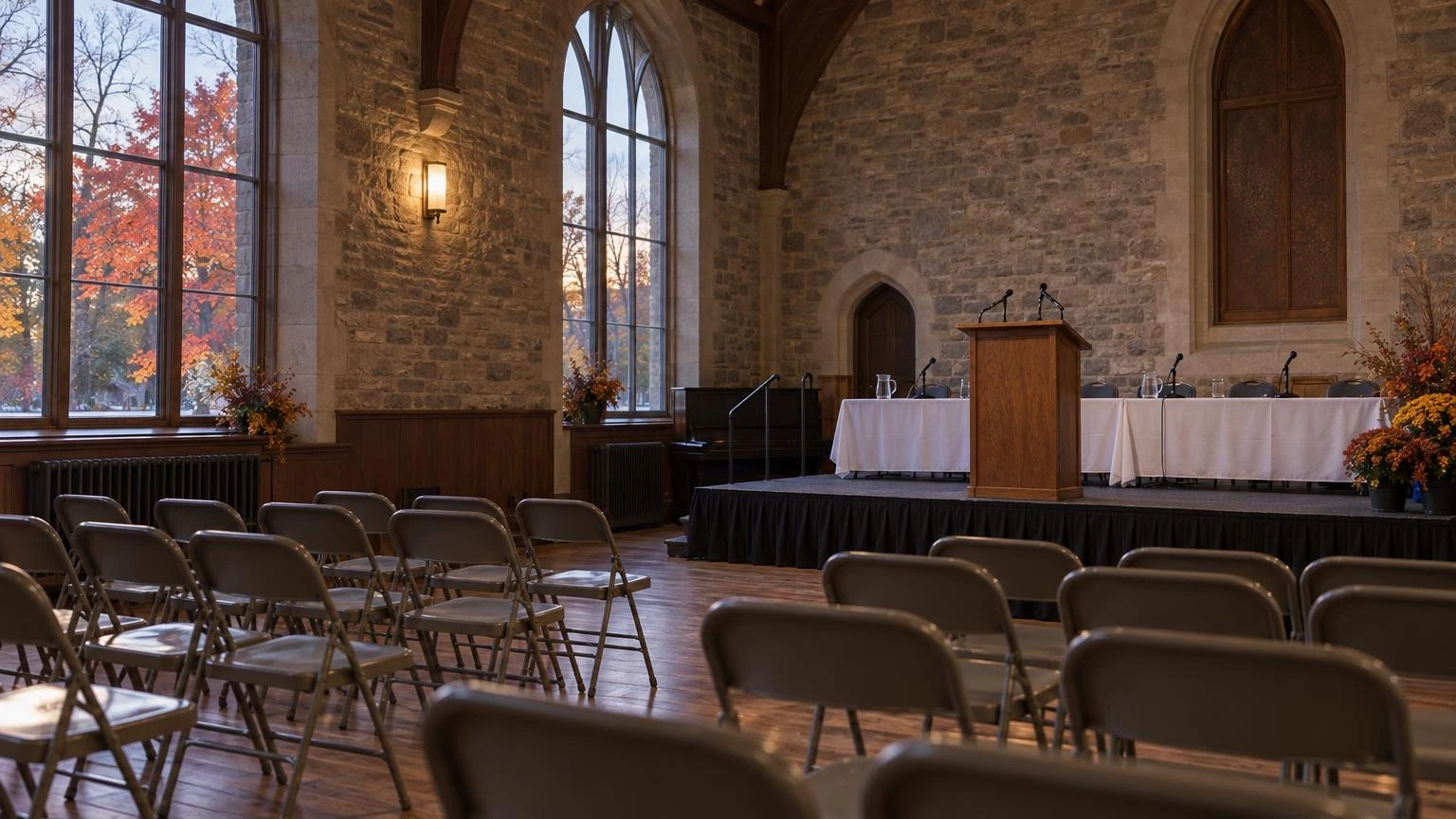
Barrie's three mayoral candidates offered competing plans for tackling homelessness, city spending and data centres during a debate Tuesday night at Grace United Church.
Incumbent Alex Nuttall, former council candidate Tanya Saari and restaurant manager Russell J. Tighe took questions from the Barrie chapter of the Canadian Association of Retired Persons, moderated by Al Jones. A fourth candidate, Kay Sayers, was invited but did not attend, according to Barrie 360.
Different approaches to homelessness
All three agreed Barrie must balance public safety with helping people in crisis, but they diverged on how. Nuttall pointed to the city's spending on downtown policing and the HART Hub, and said the next step is connecting people who refuse help with treatment. He repeated his April call for the province to fast-track legislation allowing mandatory, involuntary addictions rehabilitation.
Saari backed a housing-first model for people leaving treatment, and questioned whether mandatory treatment would work when the city already struggles to place people who want help.
"Clearing an encampment is not solving homelessness. Moving somebody, some people somewhere else in the city is not solving homelessness, and neither is a shelter bed for the night," she told the debate.
Tighe, a recovering addict, called for more outreach and stabilization teams to work alongside police. "We shouldn't even pick someone up if you can't carry them through the whole journey," he said.
Taxes and spending
Saari called for a line-by-line budget review to find duplication, and said major projects should be judged on affordability. "I want to protect the things people actually rely on, and I want to be willing to delay things we simply can't afford right now," she said.
Tighe said Barrie should reduce its reliance on residential property taxes by attracting commercial and industrial investment, proposing higher development charges on large commercial and logistics projects.
Nuttall defended his record, pointing to four consecutive years of zero-per-cent increases in the operating tax rate. He said rising overall bills stem largely from infrastructure and charges from outside bodies, including two conservation authorities and the Simcoe Muskoka District Health Unit.
Strong mayor powers and data centres
All three said they would use strong mayor powers sparingly. Nuttall said the issue was minimal in his first term. "Strong mayor's was a non-issue for this council. I didn't have anyone come and complain to me about strong mayor's one time," he said.
On a possible moratorium on new data centres, Tighe would not commit but said it is not a priority. Saari supports a pause, saying: "Nobody really has enough information to provide us with an answer right now as to what the impacts would be from environmental, to noise pollution, to water usage."
Nuttall said he is generally "not down" for data centres, but would consider one for a federal sovereignty project. "I'm going to vote for Canadian sovereignty every single time," he said.
Asked how residents should judge their records, Tighe cited reducing unsheltered homelessness, growing affordable housing and attracting investment. Saari pointed to collaboration: "I would like you to look at me as the mayor who collaborated." Nuttall set targets of 2,000 new manufacturing jobs, 800 affordable housing units built and filled, and "getting our streets back."
Ontario's municipal elections take place Oct. 26, with advance voting in Barrie beginning Oct. 22.